 2026 International Conference on Computer Perception and Neural Networks
2026 International Conference on Computer Perception and Neural Networks
2026 International Conference on Computer Perception and Neural Networks
On the afternoon of August 28, 2026, the 2026 International Conference on Computer Perception and Neural Networks (CPNN 2026) was successfully held online via Tencent Meeting and came to a fruitful conclusion. Organized by the Guangdong Digital Intelligence Technology Research Association and hosted by Shenzhen Polytechnic University, the conference was co-organized by South China University of Technology, Southern University of Science and Technology, Guangdong Computer Federation, Shenzhen Technology University, Guangdong University of Technology, Macao Science and Technology Cultural Exchange Association, and Macao Intelligent Data and Information Society. The event focused on the deep integration of cutting-edge artificial intelligence technologies with real-world applications, featuring in-depth discussions on topics such as large model-empowered virtual reality systems, AI applications in medical imaging, collaborative UAV swarm navigation, and high-resolution remote sensing image target recognition. Experts, scholars, and researchers from domestic and international universities and research institutions gathered online to explore innovative developments and future trends in AI across various fields.
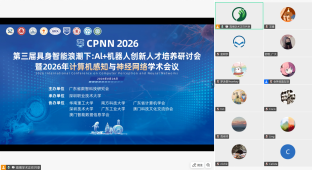
Professor Jing Huang (Beijing Normal University) presented a report titled "Applications and Innovations of Large Language Model-Empowered VR Systems". From the perspective of deep integration between large language models and virtual reality technologies, she systematically elaborated on the empowering pathways and latest research outcomes of LLMs in VR scene understanding, intelligent interaction, and content generation. She also shared innovative application practices of AI+VR in education and training, intelligent manufacturing, and medical rehabilitation, providing cutting-edge technical insights and theoretical references for the intelligent upgrading of VR systems. Online participants engaged in lively discussions following the presentation.

Dr. Anas Bilal (Hainan Normal University) presented a report titled "Are we Too Dependent on Medical Imaging? The Role of AI in Medical Imaging". He explored the role and boundaries of medical imaging in clinical diagnosis and treatment, delving into the capabilities and limitations of AI in medical image analysis, auxiliary diagnosis, and imaging quality control. He rationally examined the current clinical reliance on medical imaging, offering valuable reflections for the rational and healthy development of AI-empowered medical imaging. Scholars in attendance engaged in in-depth discussions on the reliability, explainability, and ethical boundaries of AI medical applications.

During the oral presentation session, participants from Fujian Normal University and Changchun University of Science and Technology presented research on "Collaborative UAV Swarm Navigation Based on Graph Convolutional Multi-Agent Reinforcement Learning", demonstrating innovative applications of graph neural networks and deep reinforcement learning in cooperative UAV swarm control. Another study shared was "Aircraft Detection and Fine-Grained Recognition Algorithm Based on High-Resolution Remote Sensing Images", which proposed an improved deep learning detection framework to address the challenge of aircraft model identification in remote sensing imagery.
Following the oral presentations, the conference moved into the poster session.
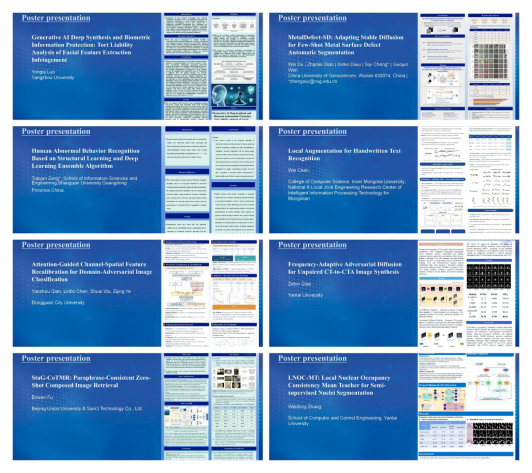
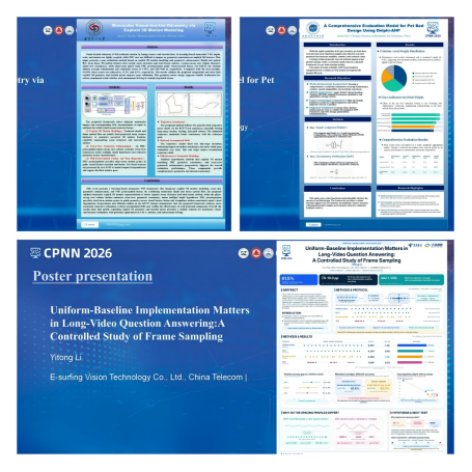
The organizing committee sincerely thanks all the presenting experts, participating scholars, and the conference support team for their dedication and hard work. We look forward to future gatherings to discuss the cutting-edge innovations in artificial intelligence, jointly promote the leap from fundamental research to applied deployment, and co-create a new blueprint for intelligent development.